Media Scrutiny and Victim-Blaming
The Birthday PartyMedia Scrutiny and Victim-Blaming is a recurring pressure around Charlie Hamilton’s disappearance: coverage can keep the case visible, but it also turns private histories into public evidence and invites blame before facts are established. Through a police press conference, reporters outside the Hamilton home, online accusations, and the contrasting treatment of other missing-child cases, the novel shows how attention is distributed unevenly—and how quickly a search for a child can become a judgment of the women connected to her.
The Press Conference and the Public Case
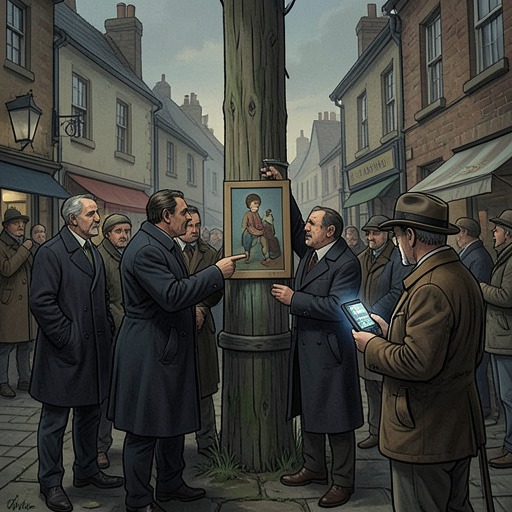
The press conference makes the difference between official information and public inference visible. Detective Chase Cooper presents Kathy Hamilton and Mitch Hamilton to the cameras as Charlie’s parents. Kathy stands behind him in pale pink trousers and a white silk blouse, looking down and clutching a tissue; Mitch, in his familiar crisp shirt and suit trousers, stares defiantly at the journalists before fixing his gaze on the camera. Their contrasting postures turn the family into an image for viewers to interpret even before the questions begin.
A reporter asks where the couple were when Charlie disappeared and notes that they were not at the birthday party. Chase says both were at work. He does not mention that Megan Carter was meant to collect Charlie for them. Megan understands that he is trying to prevent the attention shifting from the child’s disappearance to her own attack. He has explained that he would disclose the attack if he found evidence connecting the incidents, but meanwhile wants to avoid exposing her to a press that might assume she was responsible. His omission is protective, but it also shows how a reporter’s choice of what to foreground can alter the public story.
The questioning then changes direction. Tammy says she has sources claiming Kathy never arrived at the refuge that day and presses Chase to explain where Kathy really was. Mitch turns sharply toward his wife as reporters murmur. The question makes an unverified discrepancy the scene’s new focus, casting doubt on Kathy’s account in public. Megan, watching from her hospital bed, wonders whether Kathy has lied about her alibi. The conference thus does more than provide a search update: it redistributes suspicion among the family and those around it.
Megan as a Target of Blame
Megan’s experience exposes the gendered and class-coded assumptions behind public judgment. When she describes herself to a detective, she anticipates being read as suspicious because she has used drugs and alcohol in the past, works as a bartender, has tattoos, and lives in a poor apartment. She rejects the implication that such circumstances mean she seeks trouble, describing her life instead as a matter of survival. The press later makes a version of that same judgment explicit: reporters focus on her attack, while coverage presents a woman living alone in a particular part of town as if that were an invitation to violence.
As Charlie remains missing, online posts escalate from insinuation to elaborate accusations. Some claim Megan faked her injuries to conceal that she took Charlie and harmed her; others speculate that she sold the child or left her with an abusive boyfriend. These claims are unsupported, but their repetition gives them a public life of their own. Megan wants to confront the reporters outside, yet resists. At the same time, the stories intensify the temptation to take prescribed painkillers, making the scrutiny an immediate pressure on her recovery rather than a merely reputational injury.
The press is not the only source of blame. Fay Hamilton repeats online conspiracy theories to Megan’s face, accusing her of failing Charlie and suggesting that the timing of the disappearance and attack is suspicious. Mitch stops her and says she cannot believe everything online, while Kathy insists that both parents treat Megan kindly because she has endured a terrible ordeal. Kathy’s response counters the rush to blame, but the conflict shows how digital suspicion travels into family life and becomes difficult to separate from the actual search.
Unequal Attention and Exposure
Megan remembers Olivia Jenkins, who disappeared at seven after getting off a school bus in the middle of the afternoon and was never seen again. Olivia’s mother tried to keep the case in the news, but the media moved on; Megan believes viewers have little interest in families living in trailer parks. She fears that Charlie’s case will be treated differently because the Hamiltons are well known, connected, and affluent. The contrast makes visibility seem less like a neutral measure of urgency than a resource distributed according to a missing child’s family and neighborhood.
The reporters’ attention to Megan also proves unstable. From the kitchen window, she notices that their numbers are dwindling, that they arrive later, and that they leave earlier with each passing day. Their retreat makes her fear that the public is already giving up on finding Charlie. Kathy predicts renewed interest when images of Mitch and Chase driving away together are released, adding that Mitch’s attempt to hide beneath a baseball cap may make him look guilty. In this cycle, visibility can abandon a child, then return by attaching suspicion to a new image or revelation.
Reporting, Privacy, and Accountability
The book distinguishes harmful exposure from reporting that might assist the investigation. Susan Cartwright, an investigative reporter for the Vermont Daily News, tells Megan and Kathy that she has followed missing-child cases for years and has helped find a child alive. She acknowledges that the Hamiltons’ alibis have produced false starts and says she wants to examine their private lives. Crucially, she promises that what she learns will be shared with Detective Cooper rather than used simply to beat him to a story. Megan is wary of her motives, asking whether an exclusive for a national newspaper or television producer is the real prize; Susan accepts that caution rather than demanding trust.
This conversation sets out a difficult distinction. The investigation may require questions about private conduct, and new information may matter to the search, but the method and framing determine whether scrutiny serves that purpose or merely supplies an audience with a suspect. The press outside the Hamilton home, the conference question about Kathy’s refuge visit, and the online allegations about Megan all show how quickly scrutiny can outrun evidence. Susan’s stated commitment to share information with the police offers a more accountable model, though her access still depends on the family disclosing intimate details.
The Cost of Being Made Public
Public attention reaches beyond the immediate suspects and witnesses. Kathy resents reporters harassing the family at their home during the worst period of their lives. When Martha asks whether Charlie has been found and suggests that Kathy must be distraught because she has not had the child long, Kathy rejects the language of loss: Charlie is not a misplaced possession but a five-year-old who has been abducted. Her anger also refuses the consolation of unsolicited prayers. The exchange exposes how even sympathetic questions can reduce a child and her mother to a ready-made human-interest story.
Across these episodes, the novel connects the public search for Charlie with competing acts of interpretation: the police decide what to disclose, reporters choose which questions to ask, online users invent explanations, and family members absorb or resist those explanations. The result is not simply unwanted publicity. It is a struggle over who is believed, whose pain merits attention, and whether visibility will help locate a child or turn vulnerable people into convenient objects of suspicion.